We learn best by simply doing. Give it a try, see how far you get, make adjustments, and start again. For many new tasks, that works perfectly well. But sometimes, you realize that confidence alone is not enough.
To assess this properly, we use the slope model in learning and development.
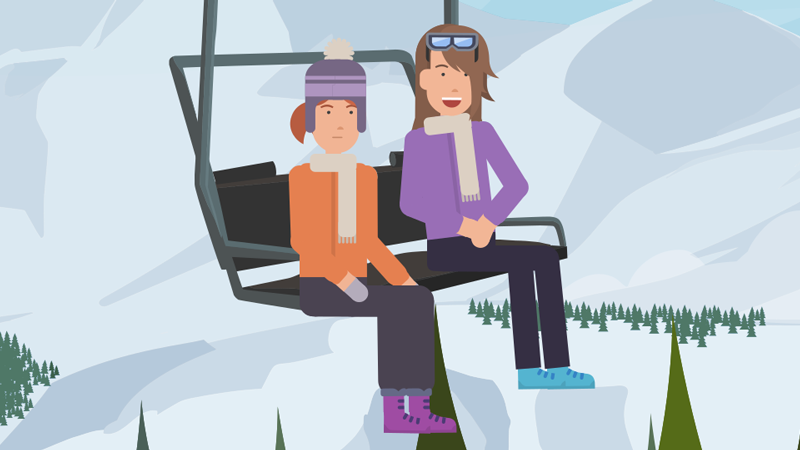
The ski lift: you always go up first
a task analysis
a concise competency matrix
insight into knowledge and skills gaps
Only when you understand what a role requires and what someone already knows and can do, can you determine the right learning and development approach.
A practice run: what can someone already do?
Anyone who has taken ski lessons knows how it works: first, you do a quick practice run. The ski instructor looks at your posture, braking technique, and overall control. That determines which group you join. Not your confidence, but your actual skills.
Organizations work the same way.
New employees demonstrate what they can already do and explain how and where they learned it. Based on that, you can determine:
Does this employee need training at all?
If so, should it be internal or external?
Should it be generic or role-specific?
Would a light-touch or intensive learning path be most appropriate?
The ski slope model helps prevent employees from ending up in training programs that are either too advanced or not challenging enough. That saves time, money, and frustration.
Choosing the right slope
Once you know what someone needs to be able to do and what they already master, you can choose the right slope.
• Green slope: no training required
The task is straightforward, low-risk, and can be learned quickly.
A brief explanation, job shadowing, or a work instruction is sufficient.
• Blue slope: practical training
The task is new, but not highly complex.
Learning by doing works very well here, as long as guidance is available.
A buddy, on-the-job training, or targeted feedback are all suitable approaches.
• Black slope: comprehensive theory and practical training
The task is high-risk, specialized, or critical to quality or safety.
This is where structured training is essential: theory, practical exercises, observation, feedback, and assessment.
This is not a slope you would send someone down without proper preparation. Just as I discovered on that blue run that felt much closer to a black slope than I had expected.
When do you choose which slope?
That depends on:
Risk: What happens if someone makes a mistake?
Complexity: How much knowledge and skill is required?
Independence: Can someone practise safely on their own?
Available guidance: Is there someone who can provide feedback?
For some tasks, a “just give it a try” approach works perfectly well.
For others, just like skiing, a lack of competence is simply not safe.
Down the mountain: smooth, confident, and well prepared
Kind regards, Ilona Rensink
ilona.rensink@eluxis.com
Linkedin: Ilona Rensink