
Benefits of writing according to STE guidelines:
- Your texts become clearer, unambiguous and to the point, for a global audience.
- Easier reuse of content reduces development costs.
- Shorter, clearer texts are more cost‑effective to translate and lead to fewer translation errors.
- For instructional content, the number of user mistakes decreases because there is less ambiguity about what the text means.
Importance
As a company, you want your employees and customers to communicate using high‑quality documentation and user support. This communication should contribute positively to their experience when using products and equipment.
Applying the principles of STE helps you improve the clarity and effectiveness of your communication.
STE Checker Tool
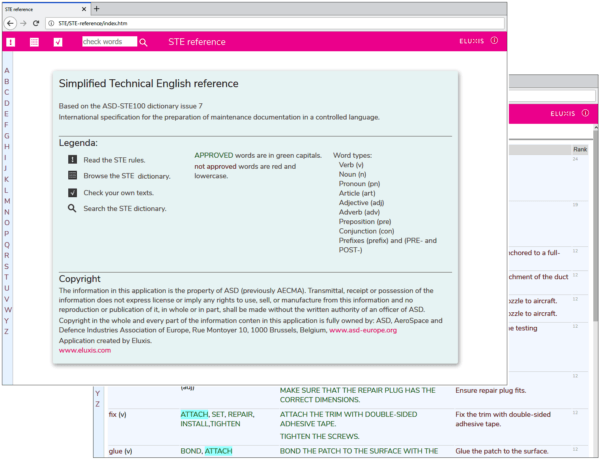
To make working with STE even easier, we at Eluxis have developed an STE Checker Tool.
This tool helps you with:
✓ Applying the STE rules
✓ Easily looking up and checking words in the STE dictionary
✓ Verifying the correct use of approved STE words in your texts
You can also make use of this tool.
Simply register and start using it right away. You will also receive our knowledge updates “Getting Started with Knowledge”.
We are currently working on improvements to the STE Checker tool and expect it to be available for download again soon.
Example of Using STE
As an example, let’s look at the following sentence:
“You must screw the bolts into the green plastic cover and hand‑tighten them.”
The STE Checker Tool helps you with this example in the following way:
Check the text in the STE Checker:

Look up the meaning and usage of a word in the STE dictionary:
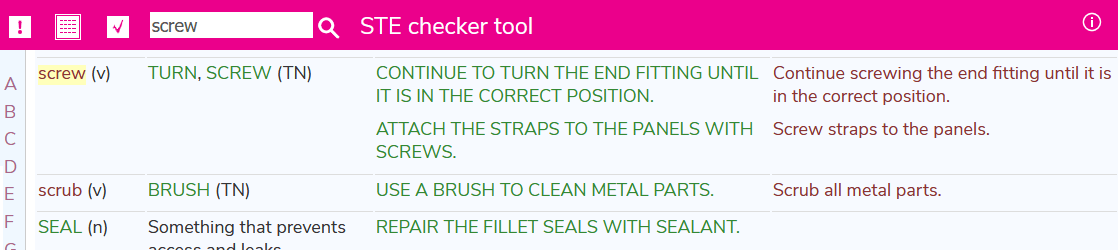
Regarding this example, we can note the following based on the STE guidelines:
- “Screw” and “hand‑tighten” are not permitted as verbs in STE (according to the STE dictionary). The word “screw” has both a verb and a noun meaning (e.g., “screw the screws”), which creates ambiguity.
- “Green plastic” does not add meaningful information for the end user, so it can be omitted assuming it is already clear which cover is being referred to.
- The word “cover” is permitted as a technical noun (technical name) in STE.
- Because this is an instruction, it must be written in the imperative form according to STE rules.
A corrected, STE‑approved, version of this sentence is:
“Insert the bolts in the cover and tighten them by hand.”
This sentence is written in an active form, making it clearer and shorter. The fact that STE leads to shorter texts is beneficial for the reader and also more cost‑effective when it comes to translation.
Start working with knowledge